The Forge
The Forge is a core component of the Beyond protocol, and is responsible for locking and unlocking tokens on Bitcoin L1 (BTC, Runes, BRC-20s...). It is a validator-controlled entity, secured by a multi-party computation scheme, and is designed to ensure the security and integrity of the Beyond protocol. The Forge's counterpart on non-Bitcoin chains are the Core and Relayer smart contracts.
Beyond will launch on mainnet with V1 in Q1 2025, and V2 in Q3 2025. As explained in the sections below, V1 has a permissioned Forge setup with a 7-of-11 multisig scheme, while V2 becomes a fully permissionless and decentralized Forge setup where anyone with a sufficiently large stake can run their own validator.
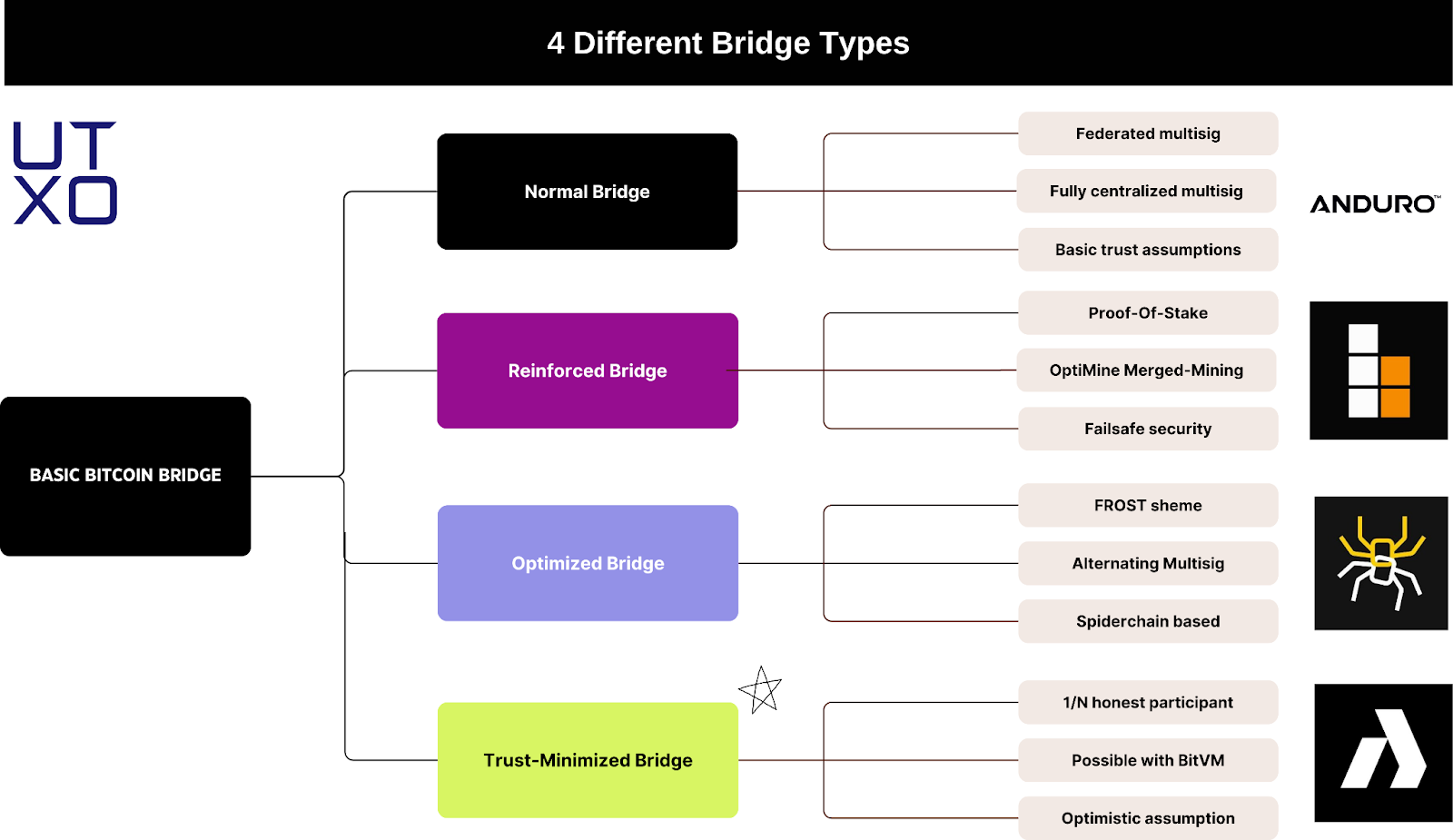
Based on the definition in the 'State Of The Bridges' report from UTXO, we can classify Beyond V1 under the Optimized Bridge category, while Beyond V2 will fall under the Trust-Minimized Bridge umbrella.
Beyond V1 — permissioned
In Beyond V1, the Forge operates as a permissioned system with a 7-of-11 validators scheme, combining Byzantine Fault Tolerance (BFT) with Proof-of-Stake (PoS) for secure cross-chain transaction validation.
Core Components
- Validator Nodes: Process and validate cross-chain transactions through stake-weighted voting
- Aggregator Nodes: Collect validated transactions and relay them to target blockchains
Key Features
- Consensus Mechanism
- BFT consensus requiring 7-of-11 quorum for transaction finality
- Dual-aggregator setup for high availability
- Economic Security
- Validators stake $BTC or $BYD tokens as collateral
- Performance-based rewards for accurate validation
- Slashing penalties for malicious behavior or downtime
- Transaction Processing
- Validators sign and verify cross-chain transactions
- Rotating aggregator nodes collect signatures and ensure quorum
- Validated transactions are posted to the Bitcoin and Ethereum mainnets
Security Measures
- Byzantine Fault Tolerance: System remains secure with up to 1/3 malicious nodes
- Cryptographic Verification: Prevents signature forgery or transaction tampering
- Dual Aggregation: Backup aggregator prevents transaction delays
- Cross-Chain Anchoring: Leverages Bitcoin and Ethereum security for transaction finality
The V1 architecture prioritizes security and reliability through its permissioned validator set, while setting the foundation for V2's transition into an open, permissionless setup.
Beyond V2 — permissionless
Beyond V2, scheduled for launch in Q3 2025 (i.e. 6-9 months after V1), transforms the Forge into a fully permissionless and decentralized system. The V2 architecture leverages Babylon and SatLayer to enable anyone to run a Beyond validator, provided they meet the necessary staking requirements.
Integration with Babylon and SatLayer
- Babylon: A non-custodial protocol enabling anyone to stake BTC to secure Proof-of-Stake (PoS) chains without wrapping or custodians, leveraging Bitcoin's native security features:
- Timestamping service
- Native blockspace
- Unmatched asset value
- SatLayer: A non-custodial Bitcoin restaking platform built on Babylon, which:
- Allows users to earn additional yields through Bitcoin-Validated Services (BVSs)
- Enhances security and liquidity across the Bitcoin ecosystem
- Provides the infrastructure for Beyond's permissionless validator set
Permissionless Validation
Through SatLayer's Bitcoin-Validated Service (BVS), Beyond V2 introduces:
- Open Validator Set
- Anyone can become a validator by meeting stake requirements
- Flexible staking options using $BTC or $BYD tokens
- Enhanced decentralization through permissionless participation
- Validator Requirements
- Minimum stake threshold (to be announced)
- Maintained uptime requirements
- Performance monitoring and accountability
- Technical specifications for running nodes
- Economic Model
- Staking rewards for active validators
- Additional yields through SatLayer's BVS
- Slashing conditions for misbehavior
- Enhanced capital efficiency through restaking
Security & Scalability
The V2 architecture maintains Beyond's high security standards while enabling greater decentralization:
- Babylon Security: Leverages Bitcoin's robust security model
- SatLayer Infrastructure: Provides reliable validator orchestration
- Economic Security: Large stake requirements ensure validator commitment
- Scalable Design: Supports growing validator set without compromising performance
This evolution to V2 marks Beyond's transition to a fully decentralized protocol, combining Bitcoin's security with modern PoS mechanisms through the Babylon-SatLayer alliance.